

The Call That Had Nothing to Do With Sales
A different end of the day
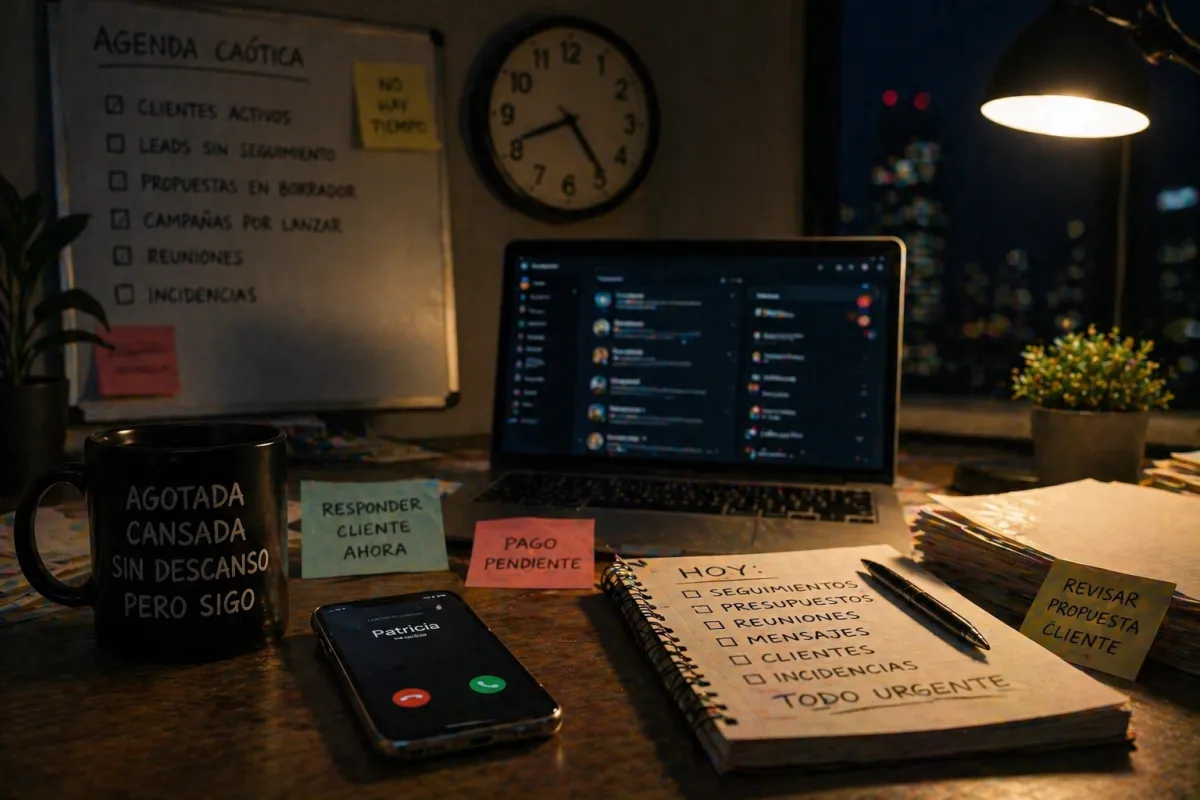
It was after eight in the evening when Patricia called. It was not a scheduled call. Nor did it seem like a commercial emergency. But from the first minute, it was clear that there was something behind it.
She did not start by talking about leads, or campaigns, or sales. She started with a much more human phrase: “I am not calling you because of clients, I am calling you because I am exhausted.”
Those kinds of phrases are important because many times they summarize a business better than any report. Patricia had an active agency. She had clients. She had income. From the outside, she did not look like an entrepreneur in trouble. But on the inside, she was living the business as a constant burden.
What cannot be seen in the numbers
When someone sees an agency with movement, they think everything is going well. But there is a part that is not seen: the energy it costs to hold everything together when there is no system.
Patricia answered messages at any hour. She did manual follow-up. She remembered tasks from memory. She organized quotes, resolved doubts, put out fires, and felt that if she disconnected, everything could fall apart.
She had clients, yes. But she had no rest.
The phrase that explained everything
In the middle of the conversation, she said something that stayed floating: “If I stop, I feel like everything falls apart.”
That phrase marks a boundary. Because one thing is to have responsibility and something very different is to be the only support of the business. When everything depends on one person, there is no freedom. There is dependence.
And that is very common in small travel agencies. The owner starts doing everything because at the beginning there is no other option. But if the structure does not change, there comes a point where growth turns into exhaustion.
The real problem
Patricia thought she needed to organize herself better. But the problem was deeper. She did not only need a more orderly calendar. She needed to stop being essential in every microtask.
There were too many things that repeated every week:
- Answers to basic questions.
- Follow-up reminders.
- Sending initial information.
- Confirmations and internal tasks.
- Manual review of open conversations.
All of that was consuming energy that should have been reserved for important decisions.
The first change
We did not start with something huge. We started with something small: detecting which tasks were repeated. Then, separating what Patricia had to do from what the system could do.
Basic responses were automated. Stages inside the CRM were organized. Reminders were defined. A simple way was created to know which lead was cold, which one was active, and which one needed human intervention.
It was not technology for the sake of technology. It was recovering control.
What happened afterward
The most curious thing was that nothing dramatic happened. The business did not fall apart. Clients did not leave. No one felt less attention. On the contrary: the system began to respond better than improvisation.
Patricia started to breathe. Not because she suddenly worked less, but because she stopped feeling that everything depended on her memory.
The lesson of the day
There is a moment when the problem is not selling more. It is better sustaining what you already have.
If your business only works when you are on top of everything, the next step is not to add more volume. It is to build structure. Because growing without a system does not free you. It exhausts you.